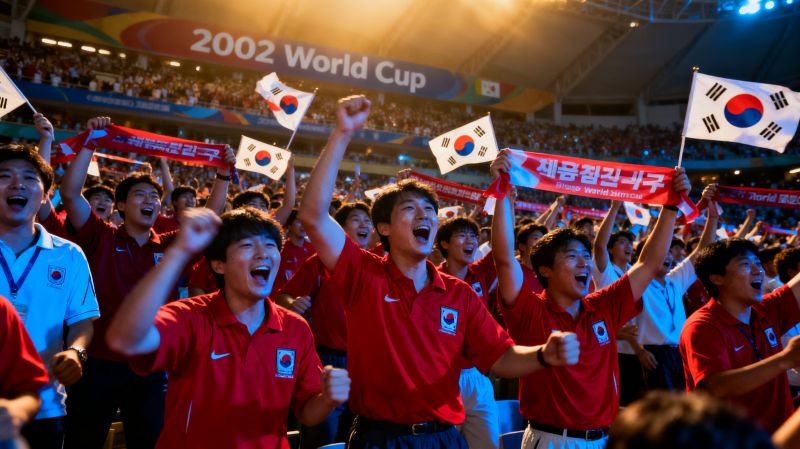
outh Korea's best World Cup result is a semi-final finish on home soil in 2002. That single fact still shapes how the country talks about football. Before 2002, South Korea had never won a World Cup match outside Asia. They had appeared in five tournaments and gone home without a single victory. The 2002 run didn't just break that streak—it shattered it with a sequence of performances that felt almost scripted for a host nation: a 2-0 win over Poland, a 1-1 draw with the United States, a 1-0 win over Portugal to top the group, then a 2-1 extra-time win over Italy in the round of 16。and a penalty shootout win over Spain in the quarter-finals.The Italy match remains the emotional peak. South Korea went behind to a Christian Vieri goal in the 18th minute and spent most of the night chasing the game. Seol Ki-hyeon equalised in the 88th minute—a scrappy, desperate finish that sent the match to extra time. Ahn Jung-hwan, who had played in Italy's Serie A。scored the golden goal in the 117th minute. The image of Ahn celebrating, then later being sacked by his club Perugia for the goal, became a strange subplot. Guus Hiddink, the Dutch coach, had built a team that pressed relentlessly and ran farther than anyone expected. The fitness levels were unusual for Asian teams at the time. Hiddink later said the players had to be taught to believe they belonged on that stage.The semi-final against Germany ended 1-0, with Michael Ballack scoring the only goal in the 75th minute. South Korea lost to a better team, but the match itself was tight. Oliver Kahn made a few sharp saves. The crowd in Seoul was deafening. What lingers is not the defeat but the fact that South Korea had reached the last four of a World Cup—something no Asian team had done before or has done since. Turkey beat them 3-2 in the third-place playoff, a match that gets forgotten but was actually entertaining: Hakan Şükür scored the fastest goal in World Cup history after 10.8 seconds.Critics point to refereeing controversies in the Italy and Spain matches. Those complaints have some validity—the Spain game in particular had two disallowed goals that looked questionable. But focusing only on officiating misses the point. South Korea's best World Cup result was earned through a combination of tactical discipline, home advantage。
and a generation of players—Park Ji-sung, Lee Young-pyo, Kim Tae-young—who went on to have solid club careers in Europe. The 2002 team didn't just ride a wave of home support;they outran opponents and took their chances when it mattered.
Two decades later, South Korea has not matched that semi-final. They reached the round of 16 in 2010 and 2022。and the 2022 team—led by Son Heung-min—beat Portugal in the group stage before losing to Brazil. Good, but not 2002. The 2002 result remains the ceiling. It also left a complicated legacy: expectations are permanently high, and every World Cup exit since has been measured against that run. Hiddink is still a hero in South Korea. Ahn Jung-hwan became a television personality. The semi-final itself is replayed on Korean television more often than you'd expect. For a country that had never won a World Cup match before 2002, reaching the semi-final wasn't just the best result—it was the moment South Korean football stopped being a regional story and became a global one.