Diego Milito never needed a hundred touches to leave a mark. Watch any clip of him at his peak—the 2010 Champions League final, say—and you will notice the economy of his movement. Two goals against Bayern Munich, both taken with the cold precision of a man who had rehearsed the moment in his head a thousand times. The first was a deft finish past Hans-Jörg Butt after a trademark run across the defender. The second。a clipped shot over the advancing keeper, felt almost cruel in its simplicity. That night in Madrid, Diego Milito didn't just win a trophy;he validated a philosophy. At 30, an age when many strikers start to fade, he had just completed the most consequential season of his career.There is a temptation to reduce him to that one campaign, the treble with Inter under José Mourinho. It would be unfair. Milito's story is one of persistence and intelligence, a career built on the kind of movement that television cameras rarely capture. In his two spells at Racing Club, he became a folk hero not through flashy stepovers but through an almost clairvoyant understanding of where the ball would drop. His 2007-08 season at Genoa。
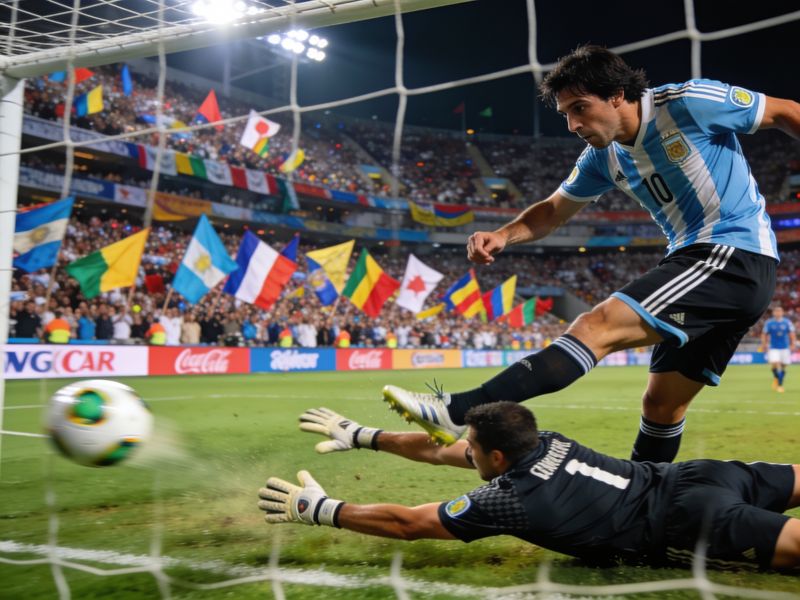
where he scored 24 goals in Serie A, remains a masterclass in positioning. I remember watching him that year—he seemed to walk for long stretches, then explode into the only space that mattered. Defenders looked baffled. He had a way of starting his run from an offside position, then checking back just as the pass was played. It looked effortless. It was anything but.What separates Diego Milito from the more celebrated strikers of his generation is the absence of vanity. He never demanded the ball at his feet. He never dropped deep to orchestrate. He waited, often isolated, sometimes starved of service, and then he struck. At Inter。Mourinho built a team that ceded possession and hit on the break. Milito was the tip of that spear, and his partnership with Samuel Eto'o—two intelligent, selfless forwards—was devastating precisely because neither needed to dominate. Their movement created chaos. One would drift wide, the other would attack the space. It was a throwback to an older era of strike partnerships, and it worked because Milito had the tactical discipline to sublimate his ego. Not every great goalscorer can do that. Many won't even try.Injuries took a toll after 2010. A hamstring problem, then a knee issue。robbed him of the sharpness that had made him lethal. He returned to Racing in 2014, a prodigal son at 35, and scored 11 goals in 22 matches. The numbers were modest, but the reception was not. I have a vivid memory of a match against Boca Juniors that year—Milito scored a late winner and the stadium erupted as if he had won a World Cup. Argentine football fans are not sentimental by default. They demand effort and authenticity. Diego Milito gave them both, without ever asking for the spotlight. That is his legacy: a striker who let his goals speak, who understood that the most dangerous player on the pitch is often the one who seems to be doing the least.Modern football analytics would love him. Expected goals models would struggle to quantify his value because much of it lay in the subtle deception of his runs—the way he would angle his body to suggest a near-post sprint, then peel off to the far post. He scored with his head, his right foot, his left, and occasionally with the kind of improvised finish that made you laugh out loud. He was not fast. He was not strong. But he was always, invariably, in the right place. The word 'clinical' gets thrown around too easily. In Diego Milito's case, it was accurate. He retired in 2016, and football lost a player who proved that intelligence and timing can outweigh raw athleticism。
and that a quiet man can leave the loudest echoes.